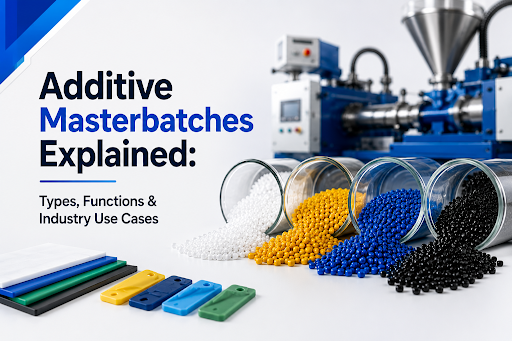
Plastics have been used in manufacturing for decades now, but each time, there was room for improvement concerning performance, aesthetics, durability, and manufacturing processes. Among the best ways that have been discovered and applied in modern plastic manufacturing processes are Additive Masterbatches. This particular concentrate contains certain additives that are mixed in carrier resin, and then they are used in the plastics, which help to improve the quality of plastic without making any changes in the fundamental structure of the polymer.
These masterbatches have a significant part in improving the performance and durability of the product in various industries, including the packaging industry, consumer goods, automobiles, agriculture, and others. It is essential to know about the types of masterbatches and their functions to select the right one for your manufacturing processes.
Masterbatches act as carriers for additives, which would not have been easily dispersed in polymers otherwise. With the help of masterbatches, manufacturers are able to ensure uniform dispersion along with improved processability and cost-effectiveness in production processes.
Additive-based products have one major function to perform: to change some characteristic properties of plastic materials. This may involve imparting such qualities as UV resistance, antimicrobial properties, antistatic characteristics, improved processibility, flame retardancy, and aesthetics.
As the additives have been pre-dispersed into carrier resins, manufacturers are able to take advantage of easy handling, less dust formation, and improved production efficiency.
Industries differ in terms of their expectations for plastic parts. Therefore, special additive masterbatches have been designed to cope with various problems.
Polymer materials that are placed under the sun can change color, become brittle, and lose their properties. UV stabilizers prevent exposure of polymers to ultraviolet light. This is especially valuable for such products as:
Such masterbatches prevent the development of bacteria, fungi, algae, and other microorganisms. These are widely used for such purposes as:
Their application provides additional hygiene and product durability.
Static electricity is one of the issues that might arise during the production, storage, and delivery of plastic parts. Antistatics protect against the buildup of electrostatic charges on polymer surfaces.
They are often applied for such uses as:
Safety standards usually demand that plastic articles be flame-retardant or fire-resistant. Some common applications for flame-retardant masterbatches are:
Such masterbatches assist the manufacturers in meeting the standards.
Plastics can have a tendency to yellow over time; optical brighteners enhance the appearance of plastics through whitening and masking the yellowness of plastics. Some of the common applications of optical brighteners include:
Manufacturers often seek unique visual effects to differentiate their products in competitive markets. Specialty effect masterbatches can create finishes such as:
These solutions help improve product aesthetics and consumer appeal.
The flexibility of Additive Masterbatches allows their use in many industrial sectors. The additives perform more functions than just modifying materials; often, they affect the performance of the final product and its ability to compete in the market.
Many additives are used to shield plastic products from various environmental stress factors, such as UV light, humidity, oxidation, or microbes. It leads to:
Some additives enhance the processing of polymers through the prevention of defects and optimization of process parameters.
These benefits include:
In industries like food packaging, pharmaceuticals, and electronics, strict requirements need to be fulfilled by companies. Additives play a crucial role in ensuring compliance with these stringent specifications.
When it comes to competitive environments, appearance may be the key factor affecting purchase decisions. Special effects additives provide a unique opportunity to create products that have a special look and feel and distinguish themselves from competitors' products on store shelves.
The packaging industry remains the largest consumer of additive-containing plastics.
Specific applications include:
Some common additives used are UV stabilizers, anti-fogging agents, antimicrobials, and antistatics.
The automotive industry makes use of modern plastic materials to decrease the weight of cars without sacrificing performance.
Specific applications include:
The additives increase durability and resistance to the environment.
Agricultural plastics are subjected to regular exposure to sunlight, moisture, and different temperature levels.
The uses include:
Protective additives are needed to ensure maximum lifespan and effectiveness in a demanding outdoor environment.
Hygiene is an important factor when it comes to manufacturing clean products.
These products include:
These additives contribute to safer and more hygienic end products.
The components must be shielded from any static discharge, heat, and environmental effects.
The masterbatch approach will help enhance:
Several factors determine the additive selection, which include:
These factors include compatibility, loading level, dispersion efficiency, and longevity of the product.
The cooperation with an expert supplier guarantees access to tailor-made compositions that meet the requirements of the particular application.
As there is an increase in the sophistication of plastic applications, there has been a need for manufacturers to have plastic solutions that are not only efficient but also functional and aesthetically pleasing. The result of the increased demand has been innovations in the world of masterbatch in the form of smart additives, processing aids, and performance-enhancing solutions.
In order to provide reliable and quality plastics, Kandui has emerged as a reliable player in the industry. Apart from Additive Masterbatches, there are some other types of products provided by the company, which include Color Masterbatches, White Masterbatches, Black Masterbatches, Filler Masterbatches & Specialty Compounds, and Engineering Plastic Compounds. Due to its focus on quality and innovation, Kandui has been assisting manufacturers in different industries through products suited to their requirements in the current market scenario.
Expert content creator passionate about sharing insights and knowledge through engaging storytelling.
View all posts