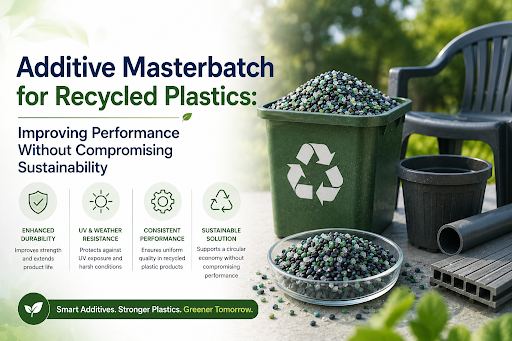
Recycled plastics have been growing in popularity fast because companies strive for sustainability and try to minimize the amount of waste they produce. At the same time, recycled polymers can pose many problems for manufacturers: poor quality, decreased strength, discolorations, odor, and inferior processing efficiency. Additive Masterbatches become helpful when a manufacturer needs to increase the performance capabilities of recycled plastics and preserve their sustainability at the same time, making recycled materials usable for various purposes.
As industries advance towards circular manufacturing, innovative additive solutions become a must-have component in creating high-performance recycled plastic parts that will meet customer and regulatory requirements.
Each cycle of plastic recycling negatively impacts its chemical and physical characteristics because of heat influence, contamination, moisture, and additional processing. As a result, plastic becomes harder to process and less resistant.
Some of the possible defects include:
Without the right modifications, recycled plastics will not have the necessary performance attributes needed in industry use.
Manufacturers need to produce sustainable products while maintaining quality at the same time. This has resulted in manufacturers shifting their focus from just recycling plastics to enhancing the recycled polymers' value.
Additive technologies have been developed by manufacturers where the process helps them restore or improve various material properties. The function of these additives is to help the products process better, live longer, look more aesthetically pleasing, and be resistant to the environment.
This approach supports both sustainability goals and long-term product reliability.
Recycled plastics are now being applied in various industries including packaging, automotive, agriculture, consumer goods, infrastructure, and textiles. Every one of these industries has different material properties required for the particular application.
The manufacturer needs to make improvements in areas like:
Through the application of Additive Masterbatches, manufacturers can tailor their recycled materials based on the performance needs of each industry.
Recycling is not merely about boosting the rate of recycling any longer. Equally significant is making sure that recycled material can retain its usefulness over several life cycles of the product.
When recycling plastic performs well:
Better performance of recycled plastics, therefore, makes the circular economy stronger by making them commercially successful for more products.
Depending on the problems of processing and performance, different additives address different issues.
Among the most common solutions are:
They increase melt flow and reduce machine wear. Moreover, processing aids allow for a smooth production process without any interruptions.
Since sun exposure quickly damages recycled plastics, UV stabilizers will be helpful in protecting the products used outdoors from rapid deterioration.
Multiple reheating of the polymer during recycling causes deterioration. Antioxidants can decrease thermal aging during manufacturing and usage.
In cases where the visual appearance of the surfaces is important, anti-scratch agents protect the product against scratches caused in the process of handling and transport.
Plastic films tend to stick to each other while being stored and processed. Anti-block agents increase the efficiency of handling and manufacturing processes.
Optical additives improve the appearance of products, making them brighter, less hazy, or more transparent when necessary.
Another misconception held by people is that the use of recycled plastic always involves sacrificing product quality. However, through improvements in material science, this has become false.
Modern producers can obtain a perfect blend of sustainability and functionality through proper selection of the correct additives depending on:
The customized selection of additives allows the use of recycled plastic in the same way as virgin plastics in several different applications.
Some industries have already found great uses for high-performance recycled plastics.
These are:
With the growing regulations promoting the use of recycled content, there will be a rising demand for performance-boosting additives.
Not all recycled polymers are alike. Different variables affect the performance of recycled plastic, such as the amount of contamination, blended polymers, history of processing, and the intended use.
The manufacturers should take into consideration:
Working with an experienced masterbatch manufacturer in India allows you to formulate an additive that meets your production and sustainable goals. Other specialized solutions can be considered depending on what a business requires. These include: Colour Masterbatches, White Masterbatches, Black Masterbatches, Filler Masterbatches & Specialty Compounds and Engineering Plastic Compounds.
Plastics’ future is not only about recycling more plastic, but about making sure that the recycled plastic is able to operate at maximum efficiency. Additive Masterbatches play an important role by connecting sustainability with functionality through better durability, better processing properties, better aesthetics, and improved quality of the final product.
When it comes to choosing a supplier with high-quality, innovative, and application-oriented masterbatch solutions, Kandui is one of the best choices available. With such a broad product range and deep knowledge about sustainable material innovation, Kandui is helping businesses to make the most of recycled plastic.
Expert content creator passionate about sharing insights and knowledge through engaging storytelling.
View all posts